Have a Big Idea, Break it in Half - Jason Fried
/
Exploring the ways in which artists, artisans and technicians are intelligently expressing their creativity with a passion for culture, technology, marketing and advertising.
In what ways are formats, standards and best practices getting in the way of your creative work?
I’ve been thinking a lot about that lately.
A couple of friends are working on a project that I encouraged them to pursue together. Every few weeks they share what they’ve created so far and I am always surprised. Even if they are executing something I suggested it is always delivered in a way that is completely different from what I imagined. Part of this process has been an ongoing conversation about formats, standards and why are things the way they are.
This project has led to a lot of questions: at which point did the formats or the media used change the creative process? Did composers write symphonies because that is what the vision was or because that was the expected form the composition should take? CDs (remember those) held approximately 75 minutes of music, but did albums need to be 75 minutes long, or could they contain less music? In the digital age, what form would an album take? Can the album be reinvented? (One could argue that iTunes LP is the album reinvented, but that is exclusive to iTunes, what would the universal new shape of an album be?) Are plays creative works meant to be read or seen in production? Is the theater of the imagination better than an actual theater? What is a theater? What is a book? A magazine? What is a website? An advertisement? Is an open source environment better than a closed system? Is HTML5 better than Flash?
Restrictions can be very helpful to the creative process. Limitations often yield the best creative solutions because of the discipline they enforce. But I worry that over time we’ve conditioned our creative process to fit the things we know to be true making innovation evolutionary rather than truly visionary. Having true visions devoid of formatting restrictions has become something we are not trained to do.
It is exciting to be at the threshold of so much change in media and technology. This is a perfect opportunity to not only create smart work, but to also take the time to question the forms the work will inhabit.
As someone that is currently looking for interesting projects and collaborators I am always asked to submit my resume first. The resume becomes the summary of my career as well as a billboard for my personal brand. The resume is the one thing that determines whether the conversation stops or continues, but there is no way that it could present the full picture. And so, all this thinking about formats, and inspired by remix/mash-up culture I decided to do an experiment.
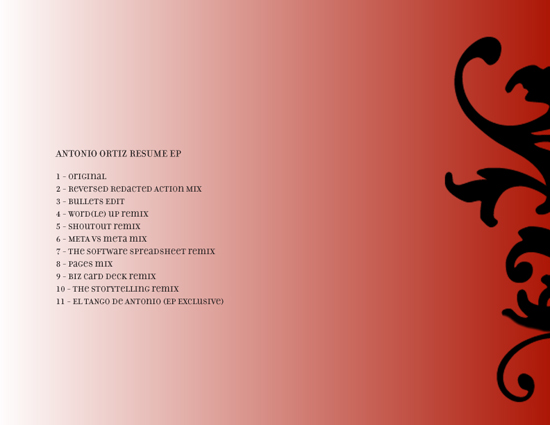
I created an EP for my resume. I developed the Antonio Ortiz Resume EP 2010, an interactive PDF which includes my original resume and nine remixes and an EP exclusive. I experimented with content and with format to present a more complete picture of my career and how I work. I’ve already thought of additional remixes to create in the future and have asked some friends to be guest remixers and create their versions of my resume while I return the favor.
Download the EP PDF here. Please take a look, see what you think. Feel free to share with anyone you think would enjoy it or find it interesting. What other remixes would you suggest? Would you remix your resume? Your personal brand? Would you allow others to do so?
And if you, or anyone you know, would enjoy collaborating with me, please let me know.
In what ways are formats, standards and best practices getting in the way of your creative work?
And what are you doing about it?

Click on image above for FREE download PDF 2.2mb
It’s true: a FREE digital version of my first book, RADICAL CAREERING: 100 Truths to Jumpstart Your Job, Your Career, and Your Life. Inside, you’ll find bite-sized nuggets ideas on creativity and your career, all wrapped in award-winning design.
A few of our favorite from the 100 Radical Truths:
The publisher very kindly agreed to let us give you this digital version for a limited time, and it’s the first time this content has been available for free. Tweet, post, and share to your heart’s content.
Happy radical-ing!
Consider it the owner’s manual to your career.
This is a continuation of a post found here.
Yesterday Apple introduced the iPad. After all the build up of anticipation and the managing of expectations via leaks to the press, the product was finally introduced. And in less than 24 hours it has gone through the whole zeitgeist cycle of want-need-hate. Most of us have not even seen or touched the device, yet we have already judged it.
This is a symptom of a 21st Century cultural malady. We are quickly loosing our capacity for wonderment and surprise. If we discover something that we then love, we immediately want to know how it was made, why, how much did it cost, how long did it take to make. Be it art, or technology, or entertainment, even news. We are loosing our ability to appreciate awe-inspiring experiences and in the process rendering them ordinary.
We do this by constantly negotiating with ourselves about how we are to have the experience. If we are expecting the release of a book, a movie, a new product, anything really, we begin an internal dialogue that looks somewhat like this:
Oh, that’s cool. Let me look that up online.
Wow, that’s really cool. Can’t wait for it to come out.
It is going to be so awesome.
I’m sure that it is going to be exactly what I want it to be and also will surprise me with unexpected twists.
I don’t know. I heard that it may not be good.
Here it comes, here it comes, almost there.
Well, how can it be everything to everyone.
Maybe they’ll surprise us and it will be better than magic.
Here it is.
Is that it?
I don’t know. I expected more.
We can no longer let things be what they are and appreciate them. Everything now has to be created with an aura of awesomeness. Not only are we loosing our capacity for wonderment, we are also loosing our capacity to be fair and effective critics.
I am by no means trying to elevate the significance of the iPad - much has been said already about the name, in three years all the jokes will be forgotten, maybe less depending on how many early adopters embrace the device. Instead I want to put it in context from the point of view of someone who clearly loves technology.
I am not an Apple cultist, some of my peers may disagree, on the other hand I’ve worked with Apple products since the late 80s and love them because at every step of my growth I was able to almost seamlessly customize them to allow me to learn more and do more. Consistently and with a minimum of irritation (compared to my experiences with other systems) I’ve been able to use Apple products as tools that adjusted to my needs and then almost got out of the way.
So here is my take on the iPad. Like almost everyone I know, my initial reaction was decidedly “is that it?” The buzz leading up to the event so hyperbolic that it really was impossible for whatever they were introducing to illicit something more than a “there’s got to be more” response.
Since then, I’ve watched the keynote, downloaded the SDK and given thought to how I could use this device.
The clipboard is now obsolete. Any job that used clipboards - for medical charts, inventory, to name a few - for easy access to information can be enhanced greatly by having this device, even more with a custom made application. The idea that as a creative services producer I can do rounds in a creative department with all of my workflow assignments, budgets, timelines, emails, project history, creative notes and briefs, everything easily available, makes me think of how much more I’ll be able to do on any given day. If companies then develop custom made apps to integrate into their current systems this could be a groundbreaking device for running day-to-day operations. I will spend the next few weeks learning how to develop for the device by producing an app that addresses all my work needs.
By embracing a few behavioral modifications the iPad could also become a productivity tool for creatives. Think of all the things that keep you from your work, your favorite distractions, twitter, facebook, rss feeds, email, all of them. Now, decide that you’ll only engage in those distractions on the iPad and you’ll only do it 3 or so times a day. In turn, your desktop or laptop then become devices used exclusively for work. By physically separating work and play into their own devices you’ll quickly notice all the ways in which the distractions encroach on your creative processes, or worse, all the ways in which we use distractions as procrastination tools.
The iPad is a 1.0 product that, much like the iPhone, will become even better in its 2.0 incarnation. It has some flaws and some limitations, but what it does it does mostly well and fast. Really fast, thanks to Apple’s own chip.
As for my beloved magazines, it is obvious now that for them to survive they need to stop thinking of themselves as publications and start thinking of themselves as applications. Because the new newsstand is the app store.
A collection of links, ideas and posts by Antonio Ortiz.
What are you looking forward to?
What has surprised you?
What have you learned today?
Copyright © 2009-2024, Antonio Ortiz. All rights reserved. Shop at Amazon.com and support Smarter Creativity.